
Introduction
The Future Homes Standard changes how new homes in England will be designed, assessed and evidenced.
New homes will require low-carbon heating, driven by updated emission factors. Solar PV becomes a separate functional requirement based on ground-floor area, not just a Part L trade-off. Fabric remains broadly aligned with Part L 2021, but limiting air permeability tightens to 4 m3/(h.m2), tested at 50 Pa. Heat-network readiness, delivery, handover, the Homebuyer Pack and Part F ventilation specifications also carry more weight.
The other major change is in the calculation engine.
The Home Energy Model, or HEM, will replace SAP as the main methodology for home energy performance. Government published the Future Homes and Buildings Standards consultation response on 24 March 2026. SAP 10.3 will be available at the Future Homes Standard launch. HEM approval is expected no earlier than 24 June 2026. HEM and SAP 10.3 are then expected to run in parallel for at least 24 months before HEM becomes the sole methodology for new dwellings, with advance notice before SAP is retired.
Housebuilders now need to decide when to switch: near the start of the transition period, or as late as possible.
The case for early adoption is clear. HEM exposes design sensitivities that SAP's monthly method averages over, especially ventilation, heat-pump operation, delivered energy and PV accounting. Early runs give design and assessment teams more time to standardise specifications, find supply constraints and prepare credible numbers for planning, ESG and customer communication.
This article draws on Vulcan and Savills Earth analysis across three new-build archetypes, modelled in SAP 10.3 and HEM:FHS, and on a Chatham House Rule roundtable with senior representatives from housebuilders, energy retailers, consultants, architects and regulators.
How HEM is different to SAP
SAP 10.3 is a monthly worksheet method. HEM:FHS runs the HEM engine at 0.5-hour timesteps under the Future Homes Standard wrapper. The practical consequence is that HEM moves several items from fixed or simplified assumptions into design decisions:
| Area | SAP 10.3 convention | What changes under HEM:FHS |
|---|---|---|
| Calculation step | Monthly simulation; heating and generation utilisation assumed. | Half-hourly timing matters. Demand, PV output and system operation can shift by time of day, so standard archetypes need testing before final compliance checks. |
| Space heating | Monthly demand with PCDB/default heat-pump efficiency, flow-temperature and plant-size-ratio rules. | Heat-pump sizing, emitter capacity, flow temperature, thermal mass and controls can change delivered heat, unmet demand and realised COP. These become design choices, not just compliance inputs. |
| Ventilation | Simplified algorithm; mechanical ventilation throughput based on 0.5 ACH plus infiltration rules. | Pressure-flow modelling uses height, flow paths, background vents, wind, stack effect and mechanical systems. Vent positions and ventilation strategy can materially change heat loss. |
| Solar PV | Appendix M annual output apportioned monthly, with self-use/export split via monthly beta factor. | PV depends on timestep weather, shading, orientation, pitch, panel ventilation and inverter behaviour. PV-rich designs need HEM checks because generation, export and primary-energy credit can move differently from SAP. |
The practical question is therefore not just whether a house type passes, but which specifications remain robust when timing, ventilation paths and heat-pump operation are modelled.
How we analysed SAP and HEM
We modelled three dwelling archetypes in both SAP 10.3 and HEM:FHS:
- Type 1: 69 m2 semi-detached home with two storeys and two bedrooms.
- Type 2: 113 m2 semi-detached home with three storeys and three bedrooms.
- Type 3: 126 m2 fully detached home with two storeys and four bedrooms.
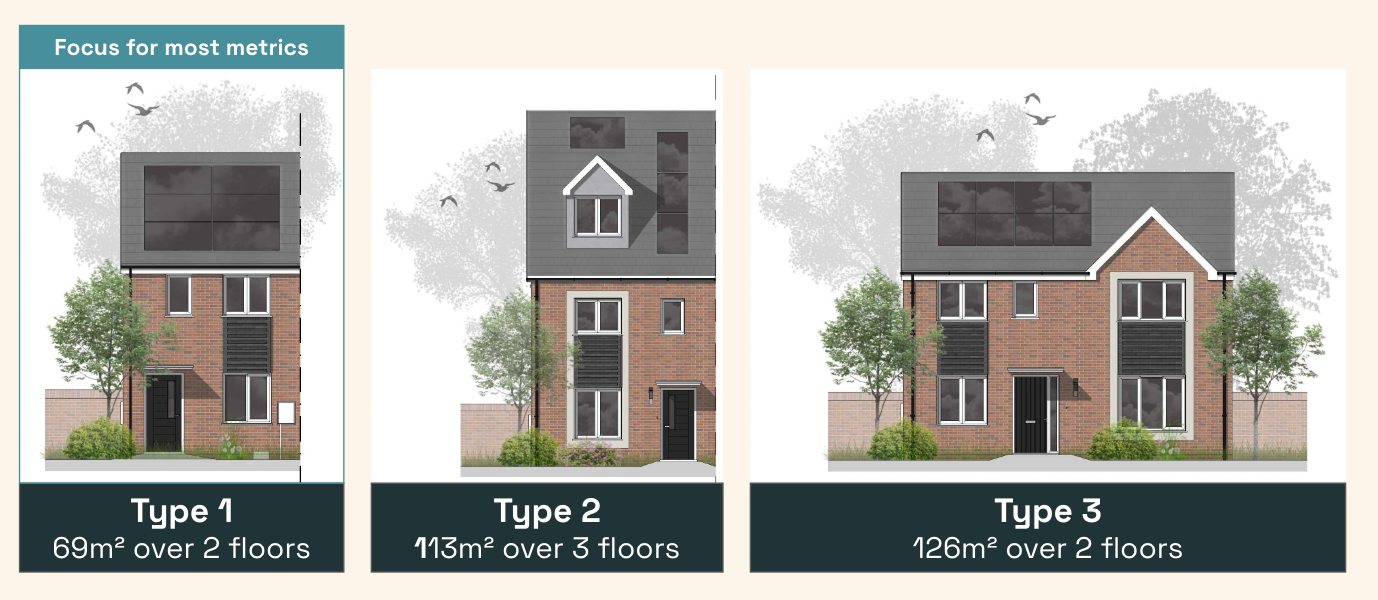
We tested two fabric specifications: a Part L 2021 baseline specification and an enhanced specification close to the Future Homes Standard notional fabric.
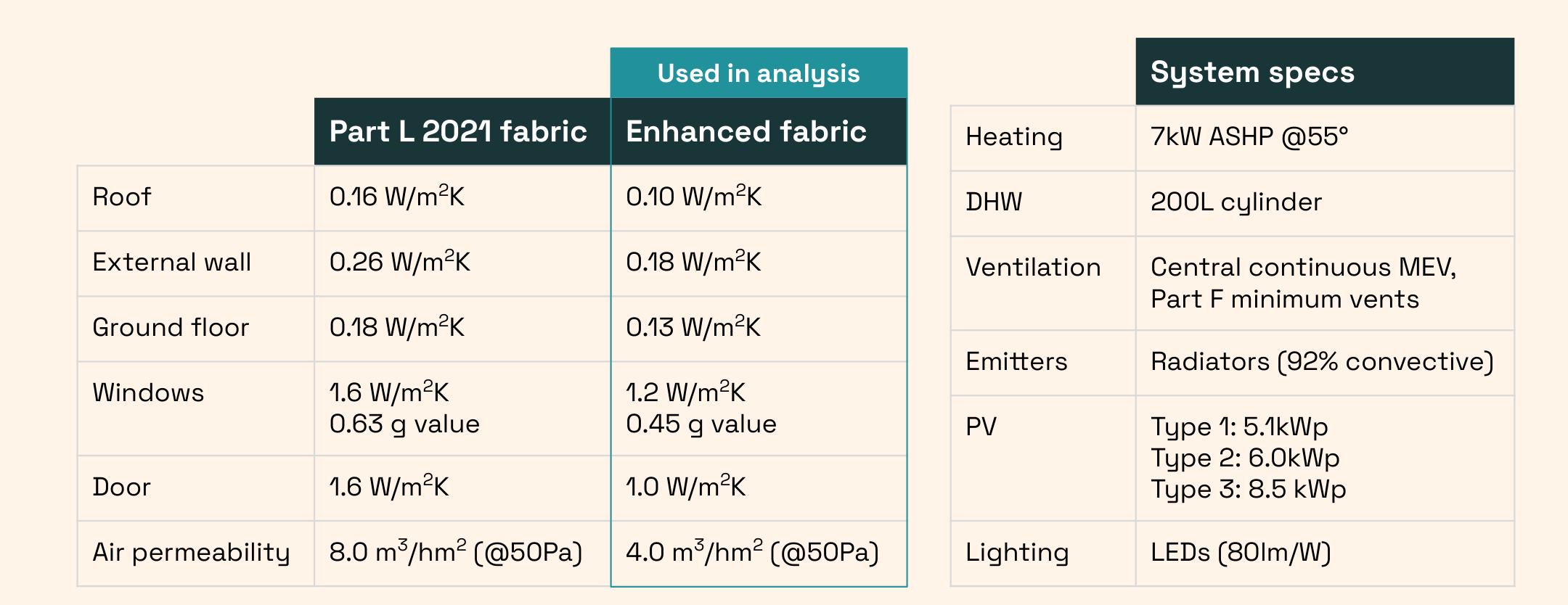
We kept the system specification as comparable as possible across engines: an air-source heat pump at 55°C flow temperature, a 200 L domestic hot water cylinder, centralised continuous mechanical extract ventilation, Part F minimum background vents, radiators, LED lighting and solar PV at approximately 190 W/m2 over 40% of ground floor area. The PV arrays were 5.1 kWp for Type 1, 6.0 kWp for Type 2 and 8.5 kWp for Type 3.
Method note: HEM runs used HEM:FHS v1.0a7 and draft FHS guidance as of 12 May 2026. SAP compliance context came from SAP compliance printouts where available. For engine comparison, we also ran XML from the same HEM inputs through the netzeroapis (https://netzeroapis.com/) SAP engine to align heat-pump assumptions more closely. Those API runs isolated model mechanics; they were not a submitted SAP assessment.
The case study passed, but margins differed
New dwelling energy efficiency compliance uses three metrics:
- Domestic Primary Energy Rate, or DPER: primary energy for regulated uses, including space heating, hot water, ventilation, lighting and generation.
- Domestic Emission Rate, or DER: the carbon emissions equivalent of DPER.
- Domestic Fabric Energy Efficiency, or DFEE: useful demand from fabric and ventilation, with system efficiencies neutralised.
Each methodology compares the proposed dwelling with its own notional dwelling, so many engine-level differences are absorbed into the target. In these archetypes, pass/fail outcomes were broadly comparable. The enhanced specification passed all three HEM:FHS metrics.
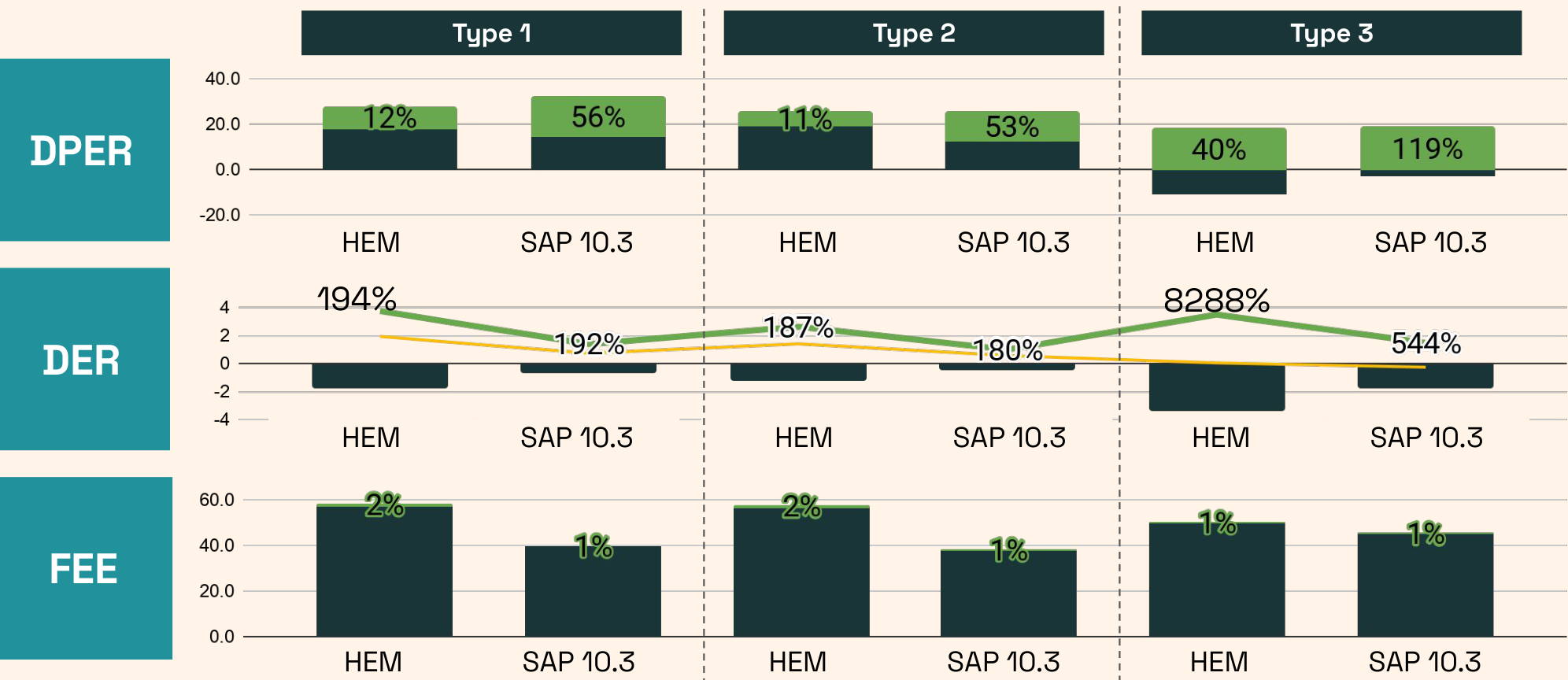
That pass result is specific to these archetypes, the heat pump, MEV and PV specification, the enhanced fabric package and each methodology's notional dwelling. The margins matter more than the headline. In HEM:FHS, DPER passed by 7.1-18.1 kWh/m2.yr and DER by 1.0-1.8 kgCO2/m2.yr, but DFEE by only 0.6-1.3 kWh/m2.yr. The enhanced fabric was deliberately close to the FHS notional fabric.
Percentage margins can mislead. Where targets are close to zero, such as DER for Type 3 with large installed PV, percentage pass can look huge. For DPER, where HEM was typically higher than SAP, percentage margins can look compressed. Absolute deltas are more stable.
Notional-dwelling rules also matter:
- HEM can be tougher where actual designs include point thermal bridges, such as balcony penetrations, because these are not mirrored in the HEM notional dwelling in the same way as SAP.
- HEM can benefit some flats because its notional dwelling excludes PV above 15 storeys, so feasible actual PV provides a gain against target.
- HEM recognises very airtight naturally ventilated dwellings, whereas SAP has a floor of AP50 3 m3/(h.m2) below which further airtightness is not credited.
- HEM explicitly models unmet demand in the actual dwelling, while sizing the notional dwelling heat pump based on peak demand.
HEM changed predicted energy use
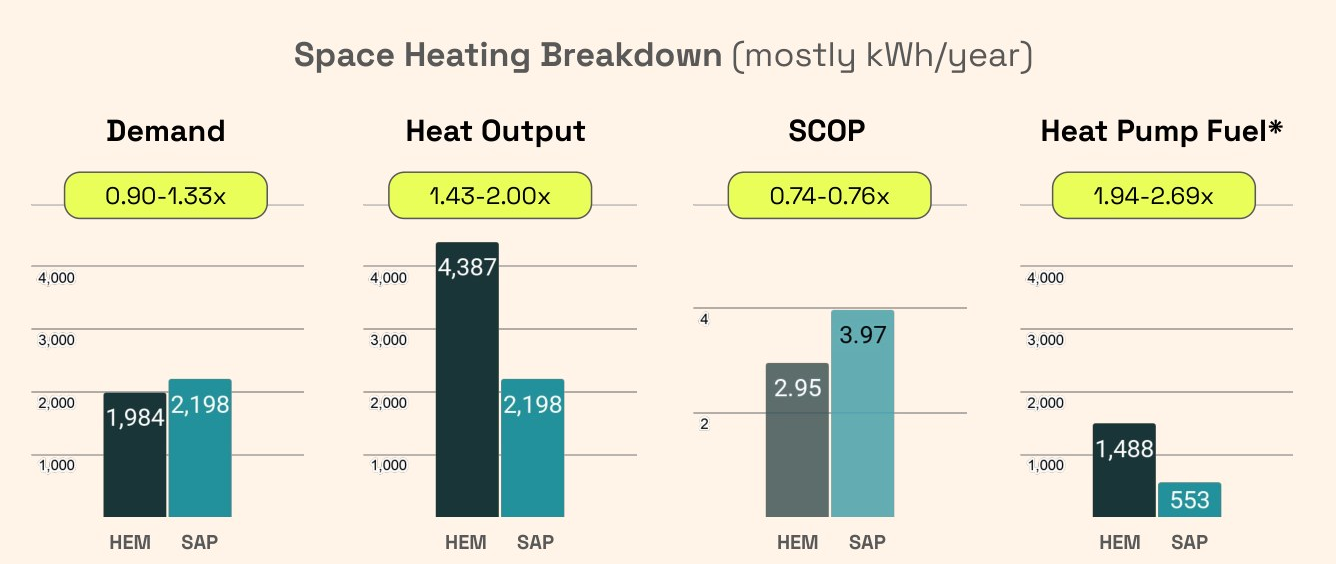
In our case study, HEM predicted materially higher regulated energy use than SAP for the same dwellings. Space heating was the clearest difference: HEM predicted space-heating fuel use at roughly 1.9-2.6 times SAP. Hot water was much closer; ventilation fan energy and lighting were lower in HEM.
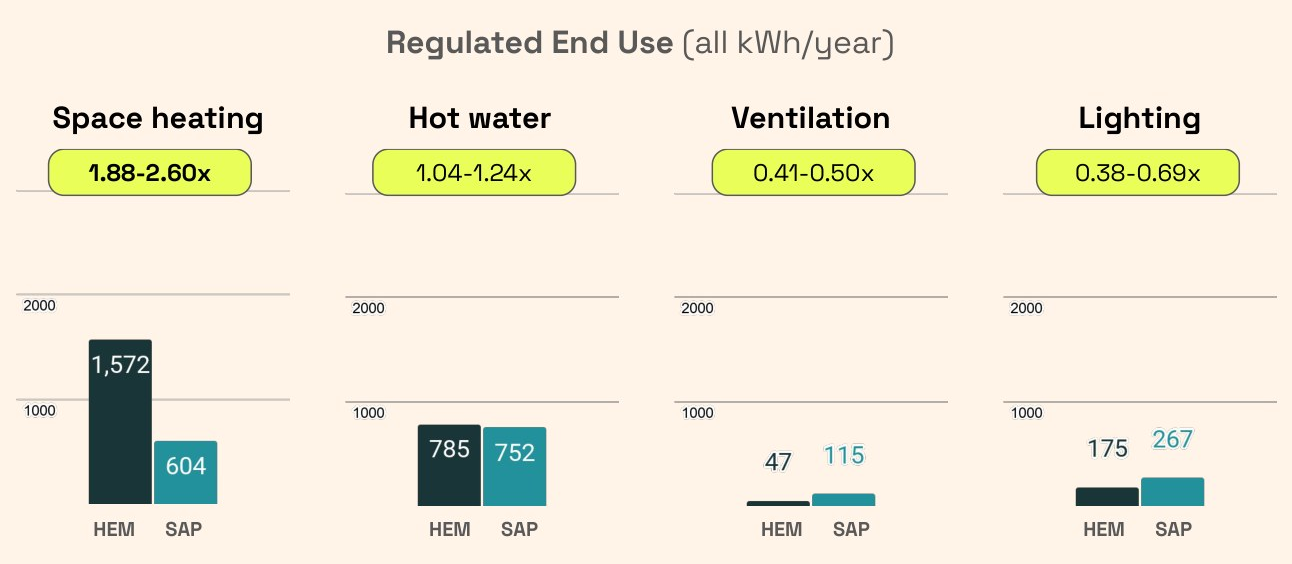
The space-heating gap came from three factors: higher heat transfer coefficient, heat-pump overshoot and lower effective heat-pump COP.
HEM predicted an 8-50 W/K higher static heat transfer coefficient than SAP. Fabric and thermal-bridge losses were mostly aligned, apart from minor differences in blinds and rooflights. The big driver of the HTC gap was HEM's ventilation model.
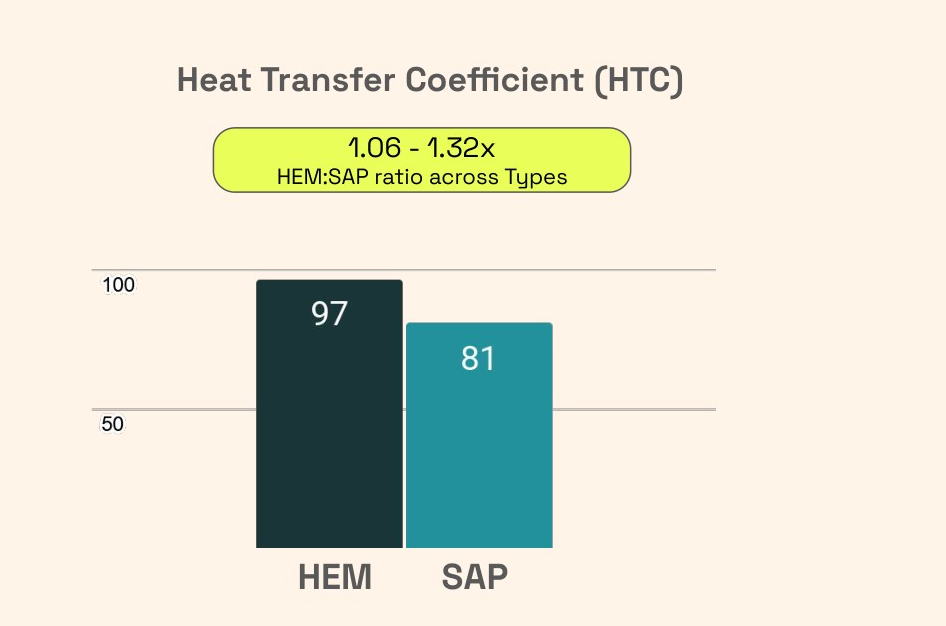
That matches the way each method treats ventilation. SAP 10.3 uses a simplified algorithm, including 0.5 ACH throughput assumptions for MEV and balanced mechanical ventilation. HEM models pressure-driven ventilation and infiltration using weather, dwelling height, air-flow path positions, background vents and mechanical systems. For developers, ventilation moves from a largely fixed compliance assumption into a design variable: background vent area and position, dwelling height, mechanical extract design flow and airtightness all influence the HEM result.
Heat pump design changes the HEM result
SAP 10.3 calculates heat-pump fuel use from monthly demand and PCDB or default annual efficiency data, with flow-temperature and plant-size-ratio rules. It does not simulate cycling against timestep demand. HEM does: output, part-load operation, flow temperature, emitter capacity, thermal mass and controls interact at each timestep.
For Type 1, the modelled heat pump was oversized relative to enhanced-fabric demand. Its minimum output sometimes exceeded immediate demand. Some heat was useful, but demand, output and efficiency shifted. Across the six variants, HEM heat output was materially higher than SAP heat output, and HEM's effective heat-pump COP was lower than the SAP SCOP used in the comparison.
In higher-heat-loss cases, undersizing can show up as unmet demand. We saw this for the Type 3 Part L 2021 specification. That affects DPER and DER in HEM in a way SAP does not capture.
Solar PV output also differs
HEM predicted roughly 1.25-1.27 times greater solar generation than SAP, with a slightly higher exported proportion.
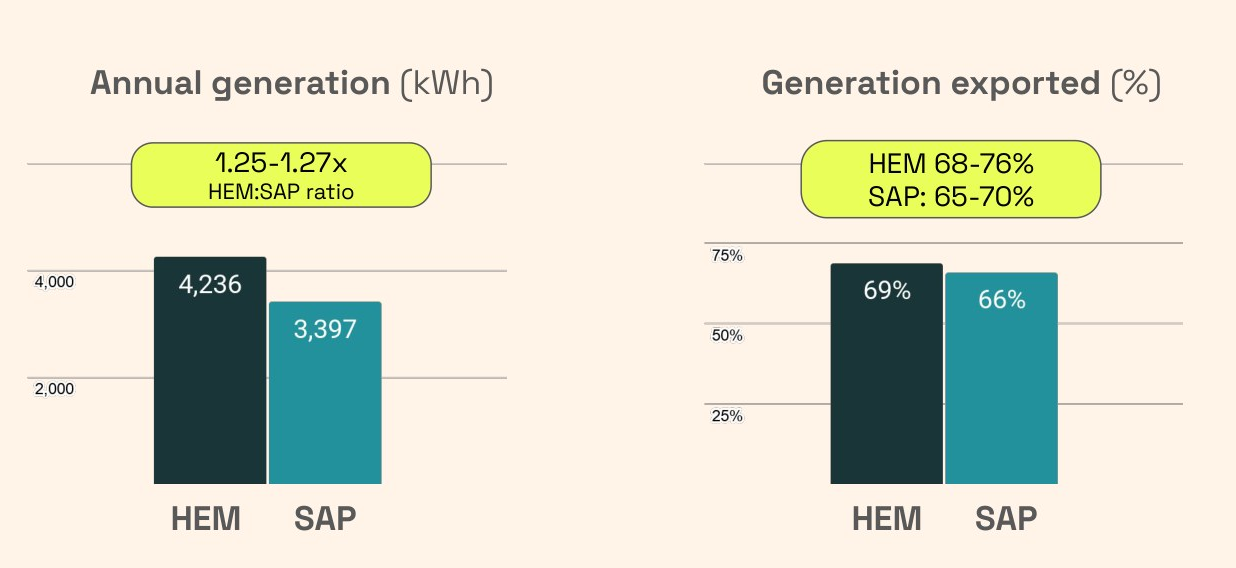
Different weather assumptions explain about 17 percentage points of the roughly 25% PV generation uplift. HEM:FHS used RAF Bedford weather, which was close to a population average; SAP used a UK Average dataset that skewed closer to a geographic average. Annual mean temperatures were close, but tilted-plane irradiance in the HEM weather file was materially higher than SAP's weather. The remaining uplift came mainly from HEM's higher assumed PV system performance factor.
Primary-energy treatment also differed. SAP 10.3 gives self-consumed solar electricity the full import primary-energy factor. HEM:FHS adds a renewable generation factor to timestep accounting, so the net credit is lower than the full avoided import factor. SAP can therefore show a more favourable DPER position for PV-rich homes than HEM, even where the underlying dwelling has not improved.
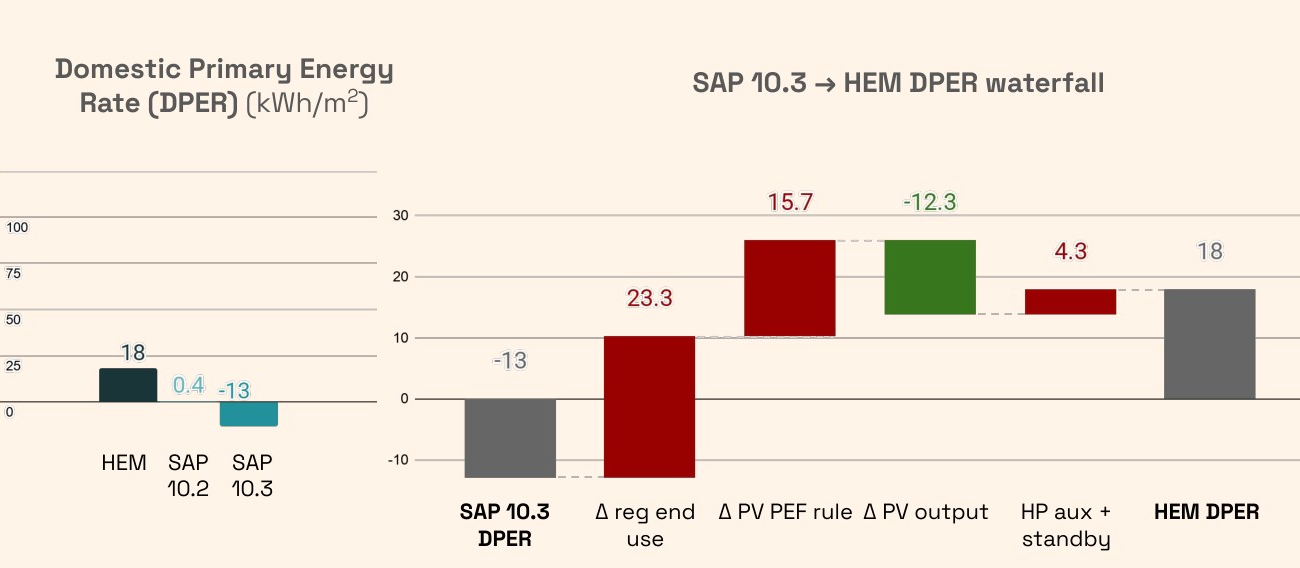
DER was more stable because SAP 10.3 and HEM use very similar flat electricity emissions factors.
Delivered-energy reporting needs care
In our analysis, HEM regulated energy use intensity was 1.34-1.69 times SAP regulated energy use. That is not just a reporting artefact. The Future Homes Standard impact assessment describes HEM as a new methodology intended to better reflect real-world energy performance, and says voluntary delivered-energy reporting through HEM will support transparency around actual energy use.
This also fits the wider measured-performance-gap evidence. UK building-performance studies have found that low- and zero-energy dwellings often underperform design specifications, with in-use energy in some studies much higher than design predictions. HEM's higher predictions should therefore be read as a more realistic signal, not simply a worse result.
What this means for housebuilders
Five practical steps follow from the case study and roundtable discussion.
1. Design for HEM's higher space heating
HEM's materially higher space-heating predictions make heating reduction more important, including efficient system design and improved fabric performance. Check heat-pump sizing, emitter strategy, flow temperatures and controls by archetype. Oversizing can reduce realised efficiency through cycling and overshoot; undersizing can create unmet demand that affects DPER and DER. Procurement may also need to become archetype-specific.
2. Design for HEM's dynamic ventilation
Ventilation strategy matters more under HEM. Test whether MVHR, different background-vent layouts or different extract flows reduce compliance risk, especially for taller homes and apartments where stack effect matters more.
3. Use HEM to shortlist alternative systems for constrained typologies
SAP treats many technologies through fixed assumptions, deemed efficiencies or conservative lookup values. That supports standardisation, but it can under-credit systems whose value depends on timing, interaction or operating conditions.
HEM is better suited to testing dynamic technologies, including exhaust-air heat pumps, hot-water-only heat pumps, smart cylinders, ventilation heat recovery, batteries, phase-change materials and advanced controls. This case study did not test all of those systems, but it shows why timing, demand shape and system operation matter. Some systems may look worse where HEM exposes weak real-world performance. Others can be credited where the timestep model shows the benefit. For constrained archetypes, especially flats, use HEM to shortlist options before specifications, supplier frameworks and product choices are locked in.
4. Fix the workflow challenge early
HEM requires more inputs than SAP: detailed geometry, element thermal properties, ground-floor calculations, solar PV inverter details, shading, ventilation, emitters, primary pipework, ventilation ductwork, blinds and appliances.
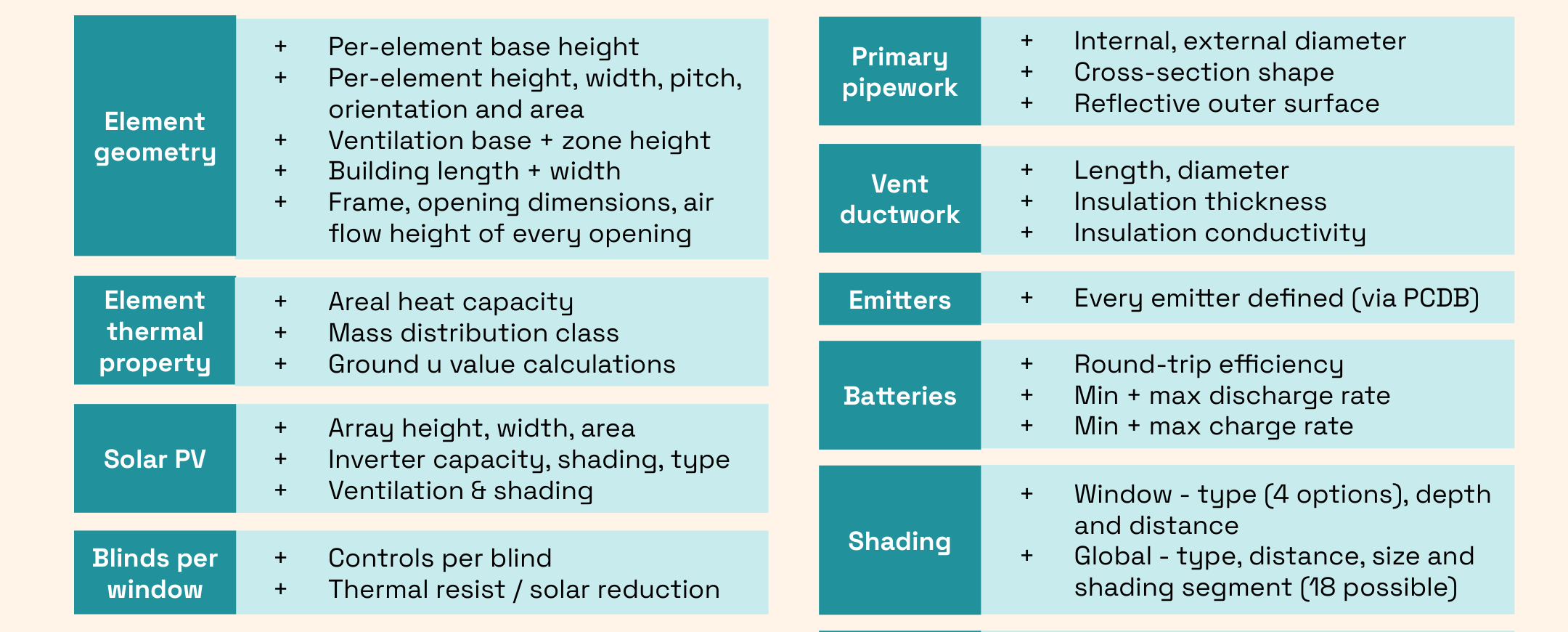
The workflow risk is not just more typing. If HEM is handled as a form-only assessment, teams will repeatedly reconstruct design intent as plans change. A floorplan- or CAD-derived model gives teams a reusable data layer: geometry can speed calculation and checking of exposed perimeter, thermal-bridge junctions and lengths, base heights, opening areas and related properties. Standard geometry, thermal attributes, fabric specifications and system specifications can then be reused across house types and projects.
5. Start using HEM where actual energy-use evidence is required
HEM predicts materially different energy use from SAP and is likely to become the more defensible source for actual energy-use evidence. That matters for planning submissions where local planning authorities have adopted energy-use-intensity policies, ESG reporting, housing association requirements, investor communication and customer-facing claims. Use the transition period to compare HEM outputs with internal benchmarks, measured data and existing SAP-derived claims, then decide which external reporting processes should move to HEM.
Closing thoughts
The Home Energy Model does not just change the pass/fail calculation. It changes what teams need to know earlier: which specifications are robust, which systems suit each archetype, and whether the data workflow can support repeatable assessments.
The transition period is the chance to answer those questions before HEM becomes mandatory.